

Department Of Chemistry
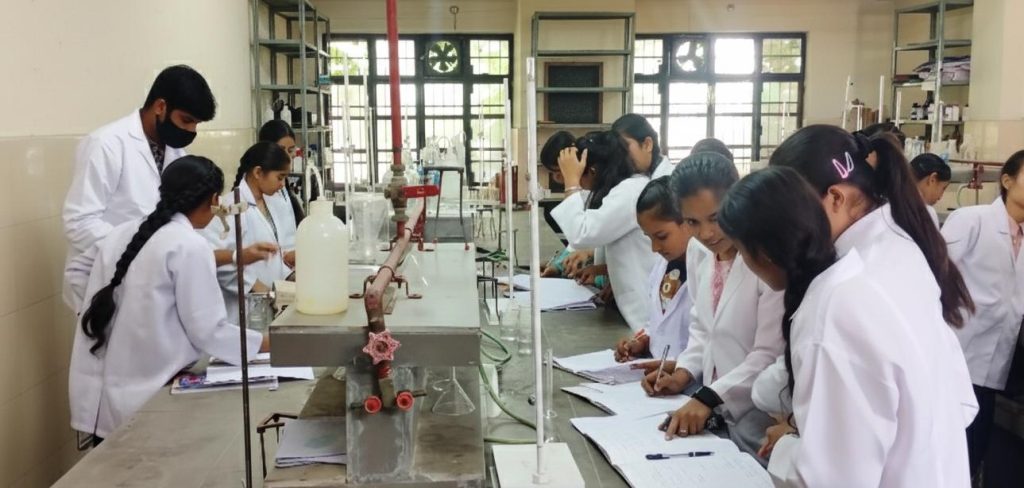
Department of chemistry, established in the year 2009, is one of the leading departments of the Govt. Arya Degree College, Nurpur. It provides a friendly and co-operative place for undergraduate science students to learn and study. The department has a dedicated faculty and non-teaching staff. The Qualified and inspiring faculty members are passionate about their subjects and use creativity with new technology in their teaching. The department maintains high standard of education through periodic tests, quizzes, seminars and lab projects. The laboratory is well equipped. The department has instruments like spectrophotometers, conductivity meters, pH meters, Digital electronic balance, Muffle furnace, Computers and other instruments; and adequate number of glassware and chemicals. Students gain theoretical as well as practical knowledge of handling chemicals that lays a strong foundation in chemistry. The teaching learning process stresses on developing scientific temperament and analytical problem solving skills in the students. Department is using audio video aids to teach classes.
Presently, the department has one Assistant Professor, two posts are lying vacant and has two Laboratory Staff members. Many students of this department have taken up teaching and research as their profession.
Student Enrolment in Chemistry
| Class | 2026-27 | 2025-26 | 2024-25 | 2023-24 | 2022-23 |
|---|---|---|---|---|---|
| B.Sc. 1st Year/1st Sem. | – | 120 | 139 | 197 | 200 |
| B.Sc. 2nd Year | – | 62 | 95 | 97 | 169 |
| B.Sc. 3rd Year | – | 62 | 70 | 89 | 183 |

Dr. Manoj Kumar
Assistant Professor
| Name | Academic Qualifications | Designation | Teaching Experience | E-mail ID | Contact No |
| 1. Dr. Manoj Kumar | M.Sc., M. Phil., Ph.D. [HPUShimla] | Assistant Professor | 4 Years | manoj90chem@gmail.com | 82620-26663 |
| 2. | Vacant | ||||
| 3. | Vacant |
Laboratory Staff
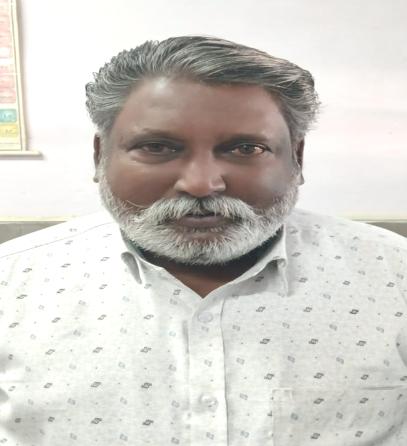
Roop Lal
Junior Lecture Assistant
Courses Offered in the Department for the session 2026-27
| Year | Discipline Specific Courses (DSC) | Skill Enhancement Courses (SEC) | MDC | Discipline Specific Electives (DSE) |
|---|---|---|---|---|
| B.Sc. 1st Sem. | Inorganic Chemistry-I, CHEM-111 | Basic Analytical Chemistry-I, CHEM-113 | Introductory Chemistry-I, CHEM-112 | |
| B.Sc. 2nd Sem. | Organic Chemistry-I, CHEM-121 | Basic Analytical Chemistry-II, CHEM-123 | Introductory Chemistry-II, CHEM-122 | |
| B.Sc. 2nd Year |
3) Solutions, Phase Equilibrium, Conductance, Electrochemistry & Organic Chemistry (CHEM-201) 4) Chemistry Of Main Group Elements, Chemical Energetics And Equilibria (CHEM-202) |
1) Basic Analytical Chemistry (CHEM-203) 2) Fuel Chemistry & Chemistry Of Cosmetics & Perfumes (CHEM-204) | ||
| B.Sc. 3rd Year |
3) Chemical Technology & Society And Business Skills For Chemistry (CHEM-307) 4) Pesticide Chemistry & Pharmaceutical Chemistry (CHEM-308) |
1) Polynuclear Hydrocarbons, Dyes, Heterocyclic Compounds And Spectroscopy (UV, IR, NMR) (CHEM-301) 2) Chemistry Of Transition And Inner Transition Elements, Coordination Chemistry, Organometallics, Acids & Bases (CHEM-304) |
Course Outcome
After the completion of B. Sc. in Chemistry the students will be able to—-
| Course Code | Title | Outcomes |
|---|---|---|
| CHEM-111 | Inorganic Chemistry-I |
|
| CHEM-121 | Organic Chemistry-I |
|
| CHEM-113 | Basic Analytical Chemistry-I |
|
| CHEM-123 | Basic Analytical Chemistry-II |
|
| CHEM-112 | Introductory Chemistry-I |
|
| CHEM-122 | Introductory Chemistry-II |
|
| CHEM201TH | Solution, Phase Equilibrium, Conductance, Electrochemistry and Organic Chemistry | To understand concepts of Solutions, Phase Equilibrium, critical solutions, electrochemistry and conductance. Preparation and properties of organic compounds like carboxylic acids, carboxylic acid derivatives, amines, diazonium salts and carbohydrates. |
| CHEM201PR | Solution, Phase Equilibrium, Conductance, Electrochemistry and Organic Chemistry | Preparation and recrystallisation of organic compounds. Distinction between reducing and non-reducing sugars. Determination of Conductance and distribution coefficient of different solutions. |
| CHEM202TH | Main Group Elements and Chemical Energetics | To understand the importance of the elements in the periodic table including their physical and chemical nature and role in the daily life. To understand the various concepts of thermodynamics, chemical & ionic equilibria. |
| CHEM202PR | Main Group Elements and Chemical Energetics | To understand the basic concepts of pH and thermochemistry through various practical using pH meter and calorimeter. |
| CHEM301TH | Polynuclear Hydrocarbons, Dyes, UV, IR and NMR spectroscopy | Methods of synthesis and chemical reactions of poly nuclear hydrocarbons, dyes and their applications. Knowledge of basic principles of UV, IR and NMR spectroscopy and their application in structure elucidation of organic compounds. |
| CHEM301PR | Polynuclear Hydrocarbons, Dyes, UV, IR and NMR spectroscopy | To perform synthesis of various inorganic compounds and their conductivity measurements. Separation of metal ions using paper chromatography. |
| CHEM304TH | Chemistry of Transition and Inner transition elements, Coordination Chemistry, Organometallics, Acids & Bases | To educate students about Principles, synthesis and applications of coordination compounds. |
| CHEM304PR | Chemistry of Transition and Inner transition elements, Coordination Chemistry, Organometallics, Acids & Bases | To educate students about Principles, synthesis and applications of coordination compounds, Preparation of solutions of acids & bases. |
| CHEM307SEC | Chemical Technology & Society & Business skills in Chemistry | Get an awareness of the impact of chemistry on the environment, society, and other cultures outside the scientific community. |
| CHEM308SEC | Pesticide & Pharmaceutical Chemistry | Knowledge of preparation, applications and side effects of various pesticides and drugs. |
