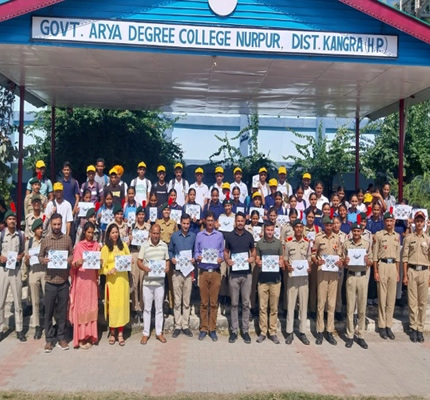
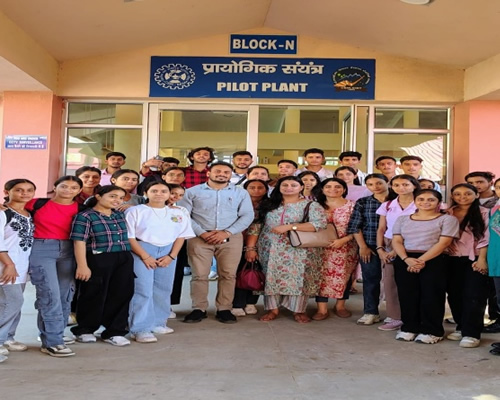
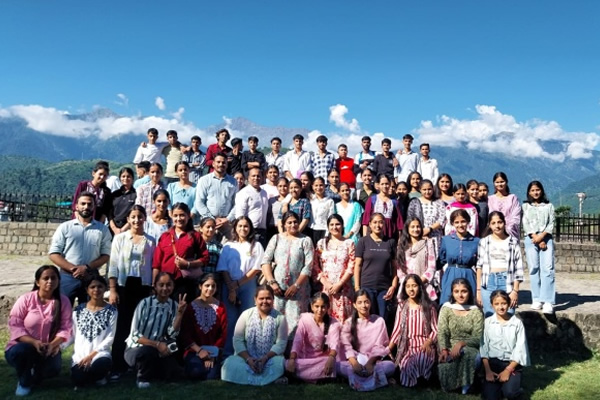
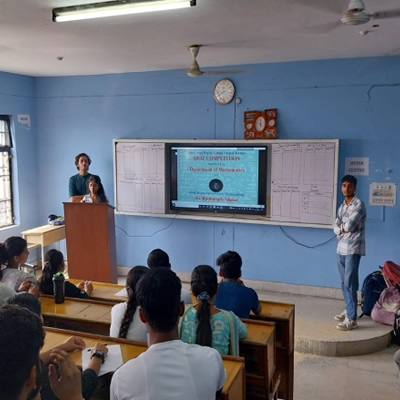
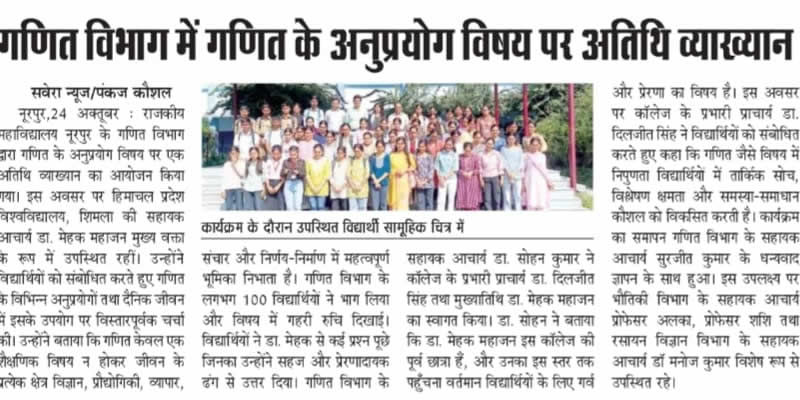
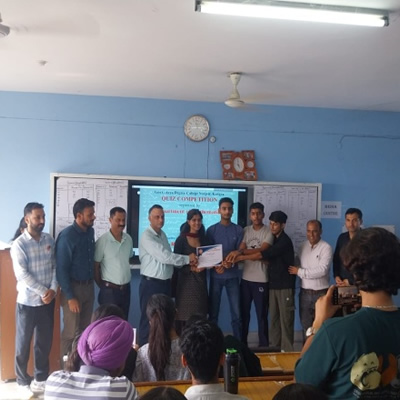
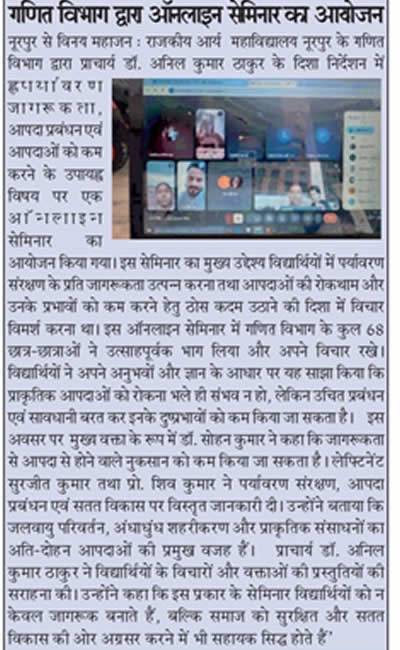
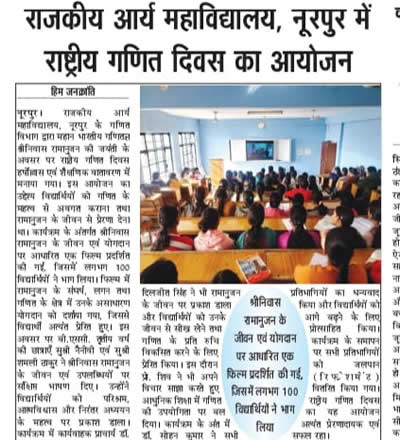
In Govt. Arya Degree College, Nurpur, Department of Mathematics, established in the year 2009, is one of the leading departments of the College. It provides a friendly and co-operative place for undergraduate science/arts student to learn and study. The department has dedicated faculty members. The Qualified and inspiring faculty members are passionate about their subjects and use creativity with new technology in their teaching. The department maintains high standard of education through periodic tests, quizzes, seminars and workshops and differemnt type of msathematical tools and software. The teaching learning process stresses on developing scientific temperament and analytical problem solving skills in the students. Department is using audio video aids to teach classes. The Department of Mathematics is an academic unit within institution dedicated to the study, teaching of mathematics. This department typically offers a range of courses, from introductory classes to advanced topics, in areas such as pure mathematics, applied mathematics, statistics, and computational mathematics.
Presently, the department has twoAssistant Professors.
Faculty members are often engaged in cutting-edge research in both pure and applied mathematics, including collaboration with other social sciences and scientific fields such as physics, computer science, commerce and economics.
Faculty Expertise:
The department is typically made up of faculty with expertise in a wide array of mathematical sub-disciplines, often with international recognition in their specific research areas.
Community Engagement:
Many departments foster a strong sense of community through seminars, colloquia, workshops, and conferences that allow students and faculty to share knowledge and collaborate.
Resources:
Mathematics departments typically have access to specialized software and tools for computation, simulation, and modeling, and they may have strong ties to industries that apply mathematical techniques.
Mathematics for Competative Examinations MDC MATH 112
B.Sc. 2nd Sem.
Ordinary Differential Equations DSC MATH 121
Logic and Sets SEC MATH 123
–
Probability & Statistics MDC MATH 122
B.Sc. 2nd Year
3) Real Analysis MATH201TH
4) Algebra MATH202TH
1) Vector Calculus MATH310TH
2) Logic and Sets MATH307TH
–
–
B.Sc. 3rd Year
3) Probability and Statistics MATH313TH
4) Transportation and Game Theory MATH317TH
1) Matrices MATH301TH
2) Numerical Methods MATH304TH
–
–
Course Outcome
Code
Course Title
Outcomes
B. Sc. Mathematics – 1st Semester
DSC MATH 111
Differential Calculus (Core Course)
Compute and analyze functions using limits, derivatives, and continuity.
Understand the method of successive differentiation and Taylor series expansions.
Develop the concepts of asymptotes, curvature and singular points.
Apply the concepts of calculus for tracing and rectification of the curves.
SEC MATH 113
Elementary Algebra
Describe the basic concepts of polynomials, types of polynomials, algebraic operations on polynomials and Euclidean algorithm for polynomials.
Explain the concept of Horner’s method of synthetic division, polynomial equations and their roots, fundamental theorems of Algebra and its applications.
Understand and find the relation between the roots and the coefficients of general polynomial equation of one variable and transformation of equations.
Reduce the general form of cubic equation to standard form of cubic by Cardon’s Method, standard form of biquadratic by Descartes’s and Ferrari’s Methods.
MDC MATH 112
Mathematics for Competative Examination
Learn the basic concepts of Mathematics needed for most competitive exams and can solve the mathematics part of competitive examinations easily.
Communicate quantitative and logical reasoning in multiple forms.
Learning the problem-solving skills.
Develop a problem-solving attitude.
B. Sc. Mathematics – 2nd Semester
Code
Course Title
Outcomes
DSC MATH 121
Ordinary Differential Equations (Core Course)
Describe basic concepts of differential equations and its solutions.
Solve linear differential equations (Leibnitz’s and Bernoulli’s equations) as well as exact differential equations and standard rule for finding their integrating factors.
Understand and solve Clairaut’s equation and its solution as well as the linear homogenous and nonhomogenous differential equations with constant coefficients.
Attain and solve various linear differential equations with variable coefficients (Cauchy-Euler and Legendre’s form).
Understand simultaneous linear differential equations with constant coefficients along with total differential equations and their solutions.
SEC MATH 123
Logic & Sets
Describe memberships of sets, including the empty set, using proper notation, and decide whether given items are members and determine the cardinality of a given set.
Perform the operations of union, intersection, complement and difference on sets using proper notation.
Draw and interpret Venn diagrams of set relations and operations and use Venn diagrams to solve problems.
Recognize when set theory is applicable to real-life situations, solve real-life problems, and communicate real-life problems and solutions to others.
MDC MATH 122
Probability and Statistics
The knowledge of the basic concepts of Statistics, its scope and importance in various fields.
The ability to master basic techniques for data summary and data presentation.
The knowledge to describe data with measures of central tendency and measures of dispersion.
The knowledge of basic concepts of probability and the ability to understand conditional probability and independent events.
B.Sc. 2nd – YEAR PAPER-I
Code
Course Title
Course Type
DSC MATH201TH
Real Analysis (Core Course)
Describe the basic difference between the rational and real numbers. Give the definition of concepts related to metric spaces such as countability, compactness, convergent etc.
Give the essence of the proof of Bolzano-Weierstrass theorem, the contraction theorem as well as existence of convergent subsequence using Cauchy’s Criteria.
Evaluate the limits of wide class of real sequences.
Determine whether or not real series are convergent by comparison test, p-test, root test and ratio test. We can also discuss the convergence of alternating series by using Leibnitz rule.
To find solutions of sequences and series of functions. We can understand the concept of point wise and uniform convergence with the help of Mn-test and M-test. Results about uniform convergence, power series and radius of convergence.
Students will be able to demonstrate basic knowledge of key topics in classical real analysis.
The course provides the basis for further studies within function analysis, topology and function theory.
DSC MATH202TH
Algebra (Core Course)
Students will be able to understand definition of group, abelian and non-abelian groups, the groups Zn of integers under addition modulo n and the group U(n), cyclic group, normal subgroups and quotient groups.
Understand group homomorphism.
Understand the basic theory of rings, commutative and non-commutative rings, polynomial rings, rings of matrices, subrings, ideals, integral domains and fields in detail.
SEC MATH307TH
Logic and Sets
Students will be able to comprehend and explain the basic principles of propositional logic.
Understand the structure of logical statements and their truth tables.
Perform operations on sets and solve problems involving union, intersection, difference and complement.
Apply De Morgan’s laws to simplify and manipulate logical and set expressions.
Understand the power set, the set of all subsets of a given set.
SEC MATH310TH
Vector Calculus
Vector calculus motivates the study of vector differentiation and integration in two- and three-dimensional spaces.
Understand scalar and vector products, reciprocal vectors, vector differentiation, scalar point functions and vector point functions.
Understand orthogonal curvilinear coordinates, gradient, divergence, curl and Laplacian operator.
Understand line, surface and volume integrals and the theorems of Gauss, Green and Stokes with applications.
Recognize its applications in science, engineering, physics, fluid flow and electromagnetic fields.
B.Sc. 3rd – YEAR PAPER-I
Code
Course Title
Course Type
DSC MATH313TH
Probability and Statistics (Core Course)
Understand the basic concepts of probability and random variables.
Study probability distributions, expectation, variance and standard distributions.
Apply statistical methods to analyse and interpret data.
Understand sampling theory, estimation and hypothesis testing.
Develop the ability to solve practical problems using probability and statistical techniques.
DSC MATH317TH
Transportation and Game Theory (Core Course)
Understand transportation and assignment problems.
Learn methods for obtaining initial basic feasible solutions and optimal solutions.
Understand the concepts of two-person zero-sum games.
Apply game theory techniques in decision making.
Develop analytical skills for solving optimization problems.
SEC MATH301TH
Matrices
Understand different types of matrices and matrix operations.
Compute determinants, inverse and rank of matrices.
Solve systems of linear equations using matrix methods.
Understand eigenvalues, eigenvectors and their applications.
SEC MATH304TH
Numerical Methods
Understand numerical techniques for solving algebraic and transcendental equations.
Apply interpolation and numerical differentiation methods.
Understand numerical integration techniques.
Apply numerical methods for solving ordinary differential equations.
Develop computational skills for mathematical problem solving.
Govt Arya Degree College Nurpur is a UGC recognized co educational institution offering Arts, Science, Commerce and vocational programs fostering academic excellence holistic student development.